
Common AI Virtual Assistant for WhatsApp Mistakes
August 27, 2026 · 11 min read
Avoid the most common AI virtual assistant for WhatsApp mistakes that slow lead response, frustrate customers, and waste ad spend.

When a lead messages after hours, the first reply often decides whether you win the conversation or lose it to a faster competitor. That is why an AI virtual assistant for WhatsApp can be a strong sales asset or a quiet leak in your pipeline, depending on how it is set up.
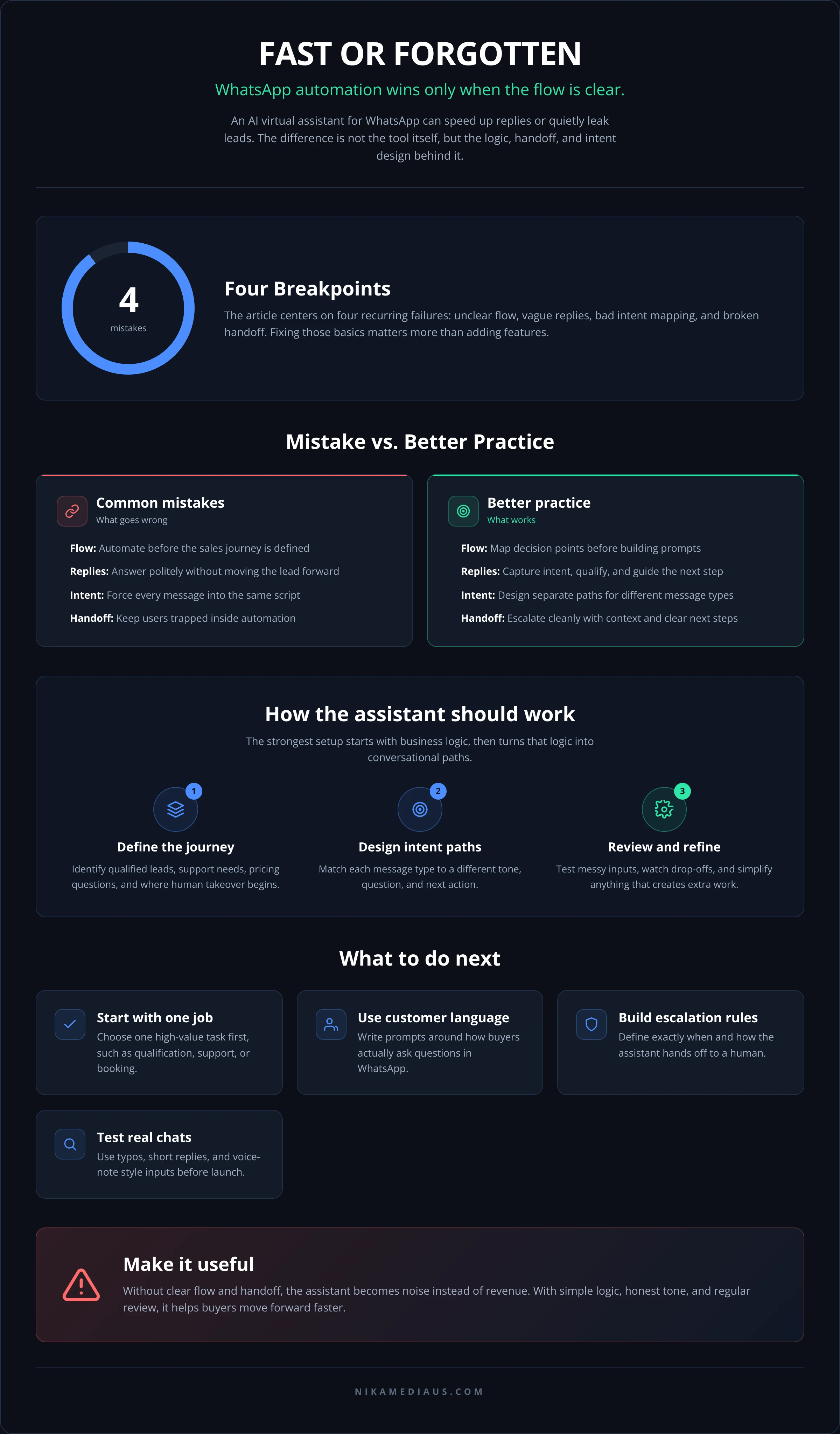
If your team is already using WhatsApp for sales, support, or follow-up, the problem is rarely the tool itself. The problems usually come from rushed setup, vague scripts, weak handoff rules, and automation that sounds smart but does not help the buyer move forward. In that kind of system, the assistant creates noise instead of revenue.
Key takeaways
- A useful assistant should reduce response time without making conversations feel robotic.
- Most failures come from poor intent mapping, weak escalation rules, and bad follow-up timing.
- Your assistant needs clean business logic before it needs more features.
- The best setup supports lead capture, customer service, and appointment flow without confusing the user.
- Testing with real conversation paths is more valuable than polishing greetings.
The first mistake: using automation before the sales flow is clear
The most common failure with an AI virtual assistant for WhatsApp is not the model, the channel, or the script. It is trying to automate a process that has not been defined well enough. If the team cannot answer basic questions like “What counts as a qualified lead?”, “Who should be handed off?”, and “What happens after someone asks for pricing?”, the assistant will guess. Guessing in sales chat is expensive.
Many businesses start by asking for a greeting, a few FAQs, and a booking flow. That sounds efficient, but it often skips the real work: mapping the buyer journey. A WhatsApp contact may arrive cold from an ad, warm from Instagram, or ready to buy after seeing a testimonial video. Those conversations should not follow the same path.
Before building the assistant, define the actual decision points. What information does sales need? What does support need? Where should the conversation stop and a human take over? A Corporate Video Production in Orlando: Pricing and Services page may not look related at first glance, but it is a good example of how a business can structure information so prospects self-select before a conversation begins. That same clarity matters inside WhatsApp.
A practical rule: if the team has never written down the ideal follow-up path for a lead, the assistant is not ready to be trained. Start with the process, then the prompts, then the automation.
A common AI virtual assistant for WhatsApp mistake: sounding helpful without moving the lead
Some assistants reply quickly and politely, but they do not advance the conversation. They answer everything in a neutral tone, offer generic help, and leave the user no clearer than before. That creates the illusion of service while the lead waits for direction.
A good sales assistant does more than acknowledge the message. It asks one useful question, reduces friction, and gives the next step. If a prospect says, “How much does the service cost?” the assistant should not dump a long paragraph and disappear. It should qualify the need and guide the person toward the most relevant option, booking link, or handoff.
This is where many setups become too cautious. Teams worry about saying the wrong thing, so the assistant says almost nothing. But the user did not message to admire automation. They want an answer that helps them decide. The safest path is not vague language; it is clear language with guardrails.
If your assistant is used for lead generation, every response should serve one of three purposes:
- capture intent
- qualify the lead
- move the contact to the next action
If a message does none of those three, it is probably bloating the conversation.
Misreading intent and forcing everyone into the same script
People do not write to WhatsApp in neat categories. Some send one word. Some paste a voice-note summary. Some ask about pricing before they explain the project. Others are already comparing options and only need a fast confirmation.
A weak assistant treats all of them like the same user. That is where it begins to fail. It offers the same canned path to a buyer who is ready to book and to a person who is still trying to understand whether the service fits. The result is friction, repetition, and drop-off.
The better approach is to design for intent types, not just keywords. For example:
- price checks
- service fit questions
- booking requests
- support issues
- post-sale follow-up
Each intent needs a different tone and a different next step. A pricing question may need a short qualifier before a quote. A support issue may need account verification and escalation. A booking request should move immediately to calendar logic or a human closer.
If your business also uses content and advertising to drive traffic, pairing the assistant with clean landing pages matters. A Video Marketing Agency in Orlando Pricing Guide is a useful reminder that buyers respond better when they can preview the scope and framing before they ask questions. The same principle applies to WhatsApp: the clearer the decision path, the fewer confused chats you get.
One more thing: if your assistant cannot handle voice notes, spelling errors, and shorthand, it is not ready for real users. Real WhatsApp behavior is messy. The automation should be able to meet that mess without sounding brittle.
Over-automating the handoff and losing the human moment
A lot of teams set up the assistant to answer the first message and then try to keep the whole conversation inside automation. That works until the contact wants nuance. Then the user gets trapped in a loop of buttons, delayed replies, or repeated questions that feel like a dead end.
The handoff is one of the most important parts of an AI virtual assistant for WhatsApp. It should not feel like the user is being passed around. It should feel like the system is making room for the right person at the right time. That usually means handing off when the lead asks for custom pricing, wants to negotiate, is ready to schedule, or shows urgency that the assistant cannot safely resolve.
A poor handoff looks like this: the assistant asks for details, stores them, and then says someone will respond later with no context. A better handoff sends the conversation summary to the human owner and tells the user what happens next in plain language.
That transition matters because users read it as competence. They are not looking for a perfect bot. They are looking for a business that responds like it knows what it is doing.
If you are building for sales, define the handoff before launch:
- which keywords or intents trigger escalation
- which team member receives the conversation
- what summary is passed along
- how the user is told to expect the next step
The handoff is also where brand trust is won or lost. If the assistant overpromises speed and the team does not answer, the channel becomes a liability instead of an asset.
Ignoring tone, compliance, and privacy in everyday conversations
Businesses often think of AI mistakes as technical mistakes. In WhatsApp, some of the biggest problems are reputational. A reply can be technically correct and still feel pushy, overly familiar, or careless with personal data.
If your assistant collects names, phone numbers, service needs, addresses, or appointment details, you need a clear privacy mindset. The WhatsApp Business Help Center is worth checking because it documents the platform’s business messaging tools and expectations. You should also treat data handling as a business process, not an afterthought.
Tone matters too. A script that sounds energetic in a brainstorm can feel awkward to a person who is just trying to reschedule. An assistant that uses too many emojis, too much slang, or exaggerated urgency can cheapen the brand fast. This is especially risky for service businesses, premium offers, and brands that sell trust more than volume.
A few practical guardrails help:
- use short, direct sentences
- avoid pretending to be human if the user clearly wants clarity
- keep consent and opt-out language visible where needed
- do not request sensitive information unless it is necessary
- keep the assistant’s role honest and limited
If your workflow involves outbound follow-up or promotional messages, check the policies carefully before scaling. Platforms change rules, and automation that ignores policy can create deliverability and account issues.
When an AI virtual assistant for WhatsApp creates more work than it saves
The easiest way to know something is wrong is simple: the team starts editing the assistant’s outputs manually every day. That does not always mean the assistant failed completely. Sometimes it means the business is still learning. But if humans are constantly cleaning up messages, re-answering the same questions, or apologizing for confusing replies, the setup is eating time instead of saving it.
A useful assistant should reduce repetitive labor in visible ways. It should answer common questions correctly, collect relevant details, and filter out obvious mismatches. It should also help the team focus on higher-value conversations instead of starting from scratch each time.
There is a similar lesson in content production and lead-gen assets. A strong Recording Studio Rental in Orlando: Pricing and Services page works because it removes uncertainty before the client asks for it. Chat automation should do the same thing: remove friction before the lead gives up.
If you want to judge whether the assistant is helping, watch for these signs:
- leads repeat the same question after the bot replies
- human agents rewrite the assistant’s message before sending it
- the assistant sends long explanations for simple intents
- users go silent after the second or third automated turn
- staff avoid using the automation because it feels unreliable
When those patterns show up, the fix is usually not “more AI.” It is better routing, clearer intent design, and simpler conversation logic.
How to build a WhatsApp assistant that actually supports revenue
The strongest setups are boring in a good way. They are not trying to impress the user with personality. They are trying to move the conversation forward with minimal friction. If the goal is lead generation, customer support, or appointment setting, the assistant should be trained around those outcomes first.
For most businesses, the best starting point is a narrow version of the flow:
Start with one channel job
Choose the single highest-value task first. That could be answering service questions, qualifying inbound leads, or booking discovery calls. Trying to cover every use case on day one usually weakens all of them.
Write for actual customer language
Use the phrases buyers already use in chat. If your audience asks “How much?” or “Do you have availability?”, build around that language instead of internal labels.
Build human escalation into the script
The assistant should know when to step aside. Not every question should be solved by automation, and pretending otherwise creates bad experiences.
Test with awkward inputs
Use typos, short replies, voice-note transcriptions, and half-finished questions. If the system only works with perfect prompts, it is not ready.
Review conversations weekly
Look for repeated failures, unanswered questions, and points where users drop off. Those patterns tell you where the workflow needs editing.
For many companies, the assistant becomes far more useful when it is connected to the rest of the marketing system: ads, landing pages, video content, and appointment booking. That is also where an agency like NIKA MEDIA can help, because the chat flow cannot be separated from the creative and acquisition side of the business. If a lead arrives confused, even a good assistant has to work harder than it should.
A polished offer, a clear message, and a simple conversation path usually outperform a flashy chatbot with a weak backend. The job is not to make the assistant seem intelligent. The job is to make the buyer feel understood quickly enough to keep moving.
FAQs
What is the biggest mistake businesses make with an AI virtual assistant for WhatsApp?
The biggest mistake is launching automation before the sales or support flow is clear. If you do not define what should happen after each type of message, the assistant ends up guessing and confusing users.
Should an AI virtual assistant answer every WhatsApp message?
No. It should handle the repetitive, predictable parts of the conversation and escalate when the request becomes custom, sensitive, or high-value. A good assistant knows when to hand off.
How do I know if my WhatsApp assistant is hurting conversions?
Watch for repeated questions, long silent gaps after automated replies, frequent human rewrites, and users asking the same thing twice. Those are strong signals that the flow is not helping the buyer move forward.
Can a WhatsApp assistant work for both leads and customer support?
Yes, but only if the flows are separated clearly. Lead qualification and support requests should not follow the same logic or tone.
Do I need a complex setup to get value from WhatsApp automation?
Not always. A simple, well-built flow that answers the right questions and hands off correctly is often more effective than a complicated system with too many branches.
How often should the assistant be reviewed?
Review it regularly, especially after ad launches, new offers, or changes in pricing and services. Conversation patterns shift fast, and the assistant should reflect the current business reality.
If your WhatsApp conversations are already generating attention but not enough booked calls or qualified leads, NIKA MEDIA can help you redesign the message flow, the handoff, and the automation around the way people actually buy. That usually starts with a tighter offer, a better content asset, or a cleaner booking path.
If you want support building a more reliable AI virtual assistant for WhatsApp alongside the creative and marketing systems that feed it, reach out to NIKA MEDIA and map the next version of your lead flow with a team that works on both the message and the conversion path.
- AI virtual assistant for WhatsApp
- WhatsApp automation mistakes
- WhatsApp sales assistant
- WhatsApp lead generation
- AI customer service on WhatsApp
- WhatsApp chatbot handoff
- business messaging automation
- WhatsApp follow-up workflow
- lead qualification on WhatsApp
- WhatsApp conversation design