
AI Sales Call Automation Mistakes to Avoid
August 28, 2026 · 11 min read
Avoid the most common AI sales call automation mistakes, from weak call flows to poor follow-up, and build calls that actually convert.

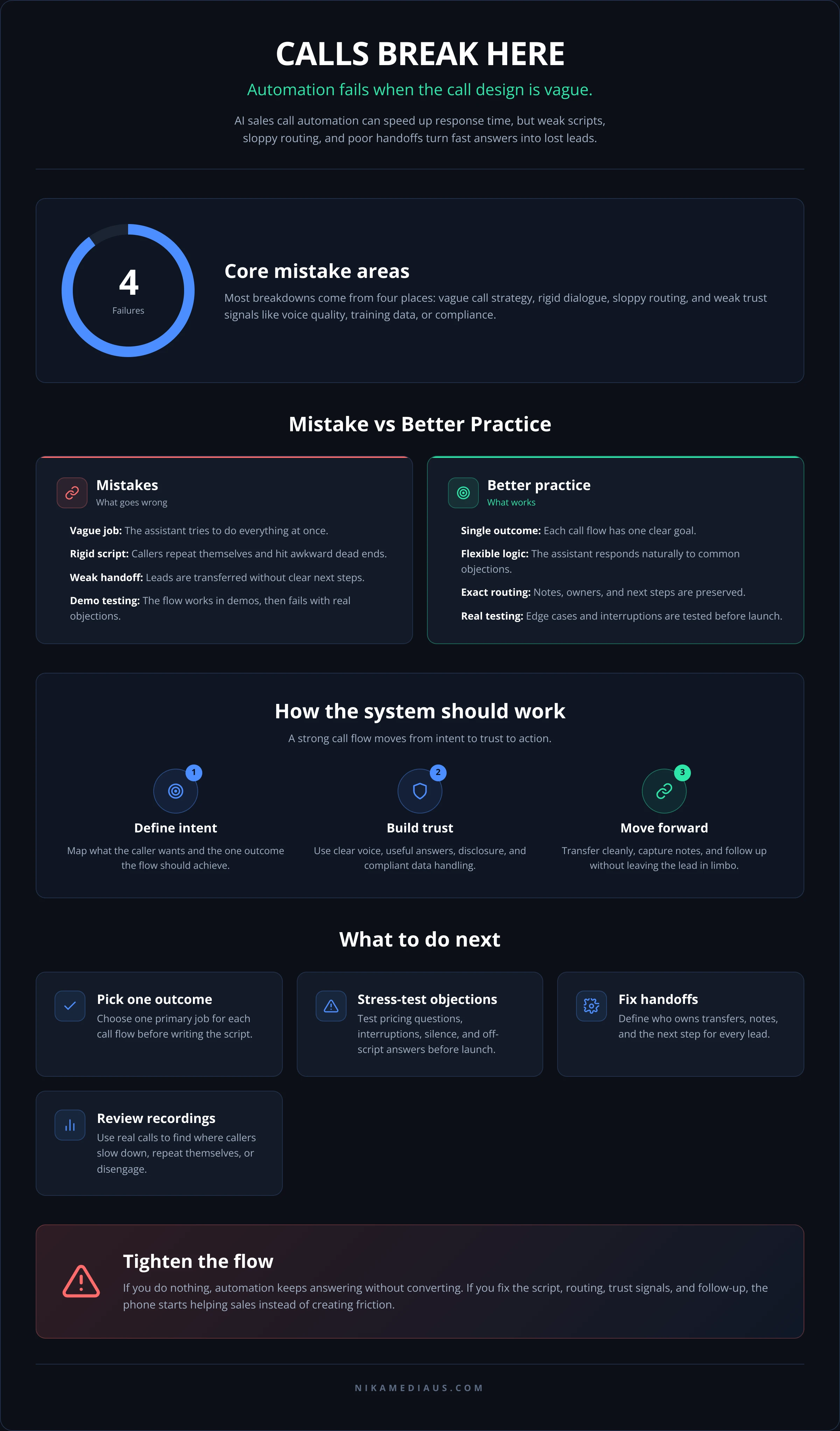
AI sales call automation fails when the call strategy is vague
The most common mistake is automating without a clear job for the call. If the system is supposed to be a receptionist, a qualifier, a scheduler, and a closer all at once, the experience becomes messy very quickly. The caller feels like they are being passed through a machine that is trying to do everything and succeeding at none of it.
A better approach is to define one primary outcome per call flow. Maybe the assistant should identify the lead, confirm the request, and book the next step. Maybe it should handle service questions and route urgent calls to a human. Maybe it should collect information for a callback without over-questioning the caller. If that outcome is not explicit, the script tends to grow into a generic conversation that sounds smart but does not convert.
This is where many businesses also copy what they hear in a promotional demo and assume the same flow will work for inbound calls, cold outreach, and customer service. Those are different jobs. A voice assistant that performs well in one scenario can feel awkward in another.
A good rule is to map the call by intent before building it. Ask what the caller wants, what information is necessary to move them forward, and what point should trigger human intervention. If the answer is fuzzy, the automation will be too.
The most common AI sales call automation mistakes in call design
A lot of teams overbuild the opening and underbuild the middle. They spend time on a friendly greeting and a catchy line, then leave the assistant to improvise once the caller starts giving incomplete answers. That is exactly where trust is won or lost.
One frequent mistake is asking too many questions too early. A lead who is simply trying to confirm availability does not want a mini-interview. Another is asking questions in a fixed order that ignores context. If the caller already gave their name and need, making them repeat it creates friction that feels careless.
There is also the problem of unnatural branching. Good AI sales call automation should know what to do when someone says, “I’m not ready yet,” “Can you text me instead?” or “I just need pricing.” If every objection leads back to the same script, callers notice. They may not say it directly, but they disengage.
Signs your flow is too rigid
- Callers repeat the same information more than once.
- The assistant asks a question that the caller has already answered.
- Common objections lead to dead ends or awkward pauses.
- Human staff spend time correcting the assistant’s handoff notes.
- Leads book less often after the system goes live, even though answer rates improve.
The fix is not more personality. It is better logic. A concise flow with clean decision points will usually outperform a long, overly friendly script that tries to sound human while ignoring how people actually speak on the phone.
Data, training, and voice quality shape trust fast
If the assistant sounds off, the conversation feels off. That can mean a voice that is too synthetic, pacing that is too fast, or phrasing that sounds translated rather than written for an English-speaking caller in the U.S. market. People are forgiving of small imperfections, but not of confusion when they are trying to buy or book something.
Training data is another quiet failure point. If the system is built from incomplete FAQs, outdated service notes, or random examples from unrelated industries, it will answer confidently and incorrectly. That is worse than simply transferring the call. A polished wrong answer can damage trust in seconds.
The same goes for voice selection and pronunciation. A caller should not have to mentally decode the assistant before they decide whether to stay on the line. If you would not want that voice representing the brand in person, it probably should not represent the brand on the phone either.
When teams work on AI sales call automation, they sometimes test only for whether the assistant responds. That is too low a bar. Test whether the response is useful, concise, and aligned with how your team sells. The caller should feel guided, not processed.
If your business also relies on messaging after the call, the consistency matters there too. The issues are similar to the ones described in Common AI Virtual Assistant for WhatsApp Mistakes: bad assumptions, weak handoff logic, and answers that sound confident but do not help the user move forward.
AI sales call automation breaks when routing and handoffs are sloppy
Many businesses focus on getting the assistant to answer and forget what happens next. That is where qualified leads get lost. If a caller should go to a rep, a booking link, or a callback queue, the handoff must be exact. Otherwise the lead is left in limbo with no clear next action.
The issue is not just technical. It is operational. If your team does not know when the assistant should transfer, who owns the transfer, and how the notes are delivered, the caller experiences a dead end even when the software itself technically worked.
A strong handoff should answer four things quickly:
- Who is the caller?
- What do they want?
- Is this a fit for immediate human attention?
- What should happen next, and who owns it?
That sounds simple until the workflow meets real-world behavior. Some leads ramble. Some ask pricing before they share context. Some are ready to book, but only if they can confirm one detail first. Your routing logic needs to handle those messy moments without forcing the caller into a rigid path.
This is also where speed matters. A lead who waits too long for the next step will often move on. The assistant does not need to solve everything instantly, but it should never create uncertainty about what comes next.
Compliance, recording, and disclosure are not optional details
If a caller is not sure whether they are talking to a person or a system, the business can create a trust problem before the conversation even starts. Clear disclosure helps. Depending on your use case, you may also need to think about consent, recording notices, and internal policies for storing call data.
This is not just a legal box to check. It affects conversion. People are more comfortable when the process feels transparent. A caller who understands they are speaking with an automated assistant is less likely to feel tricked and more likely to continue the conversation on purpose.
For businesses in the U.S., it is wise to review call recording and telecom guidance from sources like the Federal Communications Commission and to align internal practices with a clear consent approach. If your workflow handles customer data, the National Institute of Standards and Technology privacy framework is also useful for thinking through data handling and risk.
This matters even more when your automation touches SMS, voicemail, or cross-channel follow-up. The same attention to compliance applies if you later connect calls to a broader content and lead-generation system, such as a studio-produced campaign or branded video funnel. For related service planning, see Corporate Video Production in Orlando: Pricing and Services and Recording Studio Rental in Orlando: Pricing and Services.
Testing should mirror real objections, not internal optimism
The weakest implementation pattern is the one that looks great in a demo and then falls apart on the first messy call. Internal testing usually uses clean language, patient speakers, and predictable questions. Real callers do the opposite. They interrupt. They skip steps. They ask for pricing before they give context. They change their mind mid-conversation.
That means testing should include edge cases, not just happy paths. You want to know what happens when a lead is unsure, in a hurry, irritated, or only half-listening. You also want to know how the assistant behaves when it hears silence, background noise, or an answer that is outside the expected script.
A useful test plan for AI sales call automation checks three things:
What to test before launch
1. Objection handling — Can the assistant respond naturally when the caller pushes back?
2. Transfer behavior — Does the handoff preserve context and urgency?
3. Follow-up accuracy — Do notes, tags, and next steps match what the caller actually said?
If you are using a multilingual or cross-market setup, the bar gets even higher. A phrase that sounds acceptable in a written script can sound unnatural on a call. That is one reason businesses often revisit their voice and conversation strategy the same way they review public-facing brand assets on a site like saint-tropezconfidential.com when tone and presentation matter.
The important part is not to chase perfection. It is to find the points where callers hesitate, and then remove those friction points before launch.
A better operating model for AI sales call automation
The strongest systems are usually boring in the right way. They answer quickly, qualify clearly, transfer cleanly, and keep the caller moving. They do not try to sound clever. They try to be useful.
Start by defining the business outcome of each call type. Then write the flow around the caller’s most common intent, not around the internal org chart. Train the assistant on real questions your team hears every week, not on generic examples. Review recordings to see where callers slow down or repeat themselves. Those moments tell you more than a dashboard ever will.
It also helps to treat the assistant like a living sales asset. Update it when offers change, when service areas shift, or when the team changes how leads are qualified. An old script is one of the easiest ways to make automation feel careless.
For businesses that want the phone to do more than answer, AI sales call automation works best when it is built alongside other conversion assets: clear offer messaging, useful follow-up, and a brand presence that feels real. That is where a partner like NIKA MEDIA can help connect the voice experience to the rest of the lead system without turning the conversation into a stiff script.
If your calls are already getting answered but not converting, the next step is not adding more features. It is tightening the flow, fixing the handoff, and making sure the assistant speaks the same language your buyers do. That is the point where the system starts to help sales instead of just keeping the phone busy.
FAQs
What is the biggest mistake in AI sales call automation?
The biggest mistake is building a call flow without a clear business outcome. If the assistant is not designed to qualify, route, or book with purpose, it usually creates more friction than value.
How do I know if my call flow is too robotic?
If callers repeat themselves, pause often, or get stuck on simple objections, the flow is probably too rigid. Robotic systems usually sound fine in a demo but struggle with normal interruptions and off-script questions.
Should AI handle every sales call by itself?
No. Many calls still need a human handoff, especially when the lead is highly qualified, upset, or asking for custom details. The best setups know when automation should stop.
Do I need compliance steps for automated calls?
Yes. At minimum, think through disclosure, recording consent, and how call data is stored and used. Requirements can vary by state and use case, so policies should be reviewed before launch.
How often should I update an automated sales call flow?
Whenever your offer, pricing logic, routing, or qualification criteria changes. You should also review recordings regularly, because real caller behavior will expose gaps that internal testing misses.
If you want your calls to sound natural, qualify faster, and hand off cleanly, NIKA MEDIA can help you design the voice flow, the follow-up logic, and the lead capture process without turning the experience into a script that loses people. If your current setup is already live, we can audit the weak points and rebuild the parts that are costing you calls.
If you are ready to improve your AI sales call automation in a way that fits how your team actually sells, reach out to NIKA MEDIA for a practical review of your call flow, handoff logic, and conversion path.
- AI sales call automation
- automated sales calls
- voice AI for lead qualification
- sales call workflow
- AI call routing
- AI phone assistant
- call automation mistakes
- lead qualification automation