
AI Virtual Assistant for WhatsApp: Compare Options
September 1, 2026 · 12 min read
Compare an AI virtual assistant for WhatsApp by features, setup, lead handling, compliance, and support before you choose a platform.

- A good AI assistant should answer fast, qualify leads cleanly, and know when to hand off to a person.
- The best choice depends less on flashy demos and more on message quality, setup time, and control.
- If your WhatsApp inbox drives sales, missed context is often more expensive than missed speed.
- Compare how each option handles intent, follow-up, handoff, and reporting before you commit.
- Build around your actual sales process, not around the tool’s most advertised feature.
The first sign you need an AI virtual assistant for WhatsApp is usually not a tech problem. It is the second or third time in a week that a lead asks the same question after hours, your team replies late, and the conversation goes cold before anyone can qualify it properly. By then, the issue is not just response time; it is the lack of a clean system for turning chat into revenue.
That is why comparing options with confidence matters. A solid assistant can help a business answer common questions, route serious buyers, and keep conversations moving when nobody is online. A weak one can sound robotic, collect the wrong information, or create more cleanup work than it saves.
For teams that rely on WhatsApp for lead generation, customer support, or both, the decision is rarely about choosing the “smartest” tool. It is about choosing the one that fits the way people already buy from you.
What a strong WhatsApp assistant should do
An AI virtual assistant for WhatsApp should do more than send a polite greeting. It should recognize why someone wrote, respond in a way that fits the situation, and move the conversation toward the next useful step. That next step might be booking a call, sharing a link, confirming an appointment, or collecting the details your sales team needs.
The best assistants are not judged by how many answers they can generate. They are judged by how consistently they handle real conversations without losing context. If a lead asks, “Do you work with my industry?” and then follows with, “Can I see examples?” the assistant should stay coherent across both messages instead of restarting the exchange.
That is where many businesses get disappointed. They expect a chatbot, but what they need is a sales assistant with boundaries, judgment, and a clear handoff path. If your conversations are already tied to offers, calendars, or qualification steps, the assistant should support that flow instead of forcing you to rebuild it.
How to compare an AI virtual assistant for WhatsApp
When you compare an AI virtual assistant for WhatsApp, ignore marketing language for a moment and look at the mechanics. Ask what the assistant actually reads, what it remembers, what it can ask, and what it does when it is not sure. Those details matter more than the promise of “24/7 automation.”
A useful comparison usually starts with five questions:
1. Can it understand your actual offers?
If the assistant cannot explain your service structure, it will not qualify leads well. A studio rental, a video production service, a mentor program, and a lead-generation offer all need different logic. The same goes for service businesses that sell by call versus those that sell through a booking link or a quote request.
This is where setup quality matters. Some platforms depend on generic prompts and hope for the best. Others let you map knowledge, control responses, and define fallback behavior so the assistant knows when to ask a clarifying question instead of guessing.
2. Does it qualify leads or just reply?
Replying is easy. Qualifying is harder, and it is the part that actually affects revenue. A proper assistant should be able to ask for intent, budget range, location, timing, project type, or any other field your team uses to decide who gets attention first.
If your team already uses a CRM or lead sheet, the assistant should fit into that process. If it gathers names but not intent, or if it collects details in a messy format that no one can use, it is creating work instead of removing it.
3. How does it hand off to a human?
This may be the most important comparison point. A strong assistant knows when a conversation needs a person, and it transfers cleanly without making the lead repeat everything. That handoff can happen because the question is too specific, because the buyer is ready to buy, or because the issue is sensitive.
Look closely at how the platform handles escalation. Can it notify the right person? Can it preserve chat history? Can it flag high-intent leads? If the answer is vague, the “automation” may end up breaking your sales process.
4. What does setup really require?
Some tools look simple in a demo and then become complicated during implementation. Others need a clear conversation design upfront but are easier to operate once they are live. The right choice depends on your team’s capacity, your timeline, and how much control you want over message quality.
For businesses that want the assistant tied to a sales pipeline, ad funnel, or booking flow, setup should include the full journey, not just a greeting message. If you need the assistant to work with a website form, a calendar, or a follow-up process, ask how that connection is handled before you commit.
A useful reference point is the broader automation stack around the assistant. If your workflows also depend on pages, forms, or booking tools, compare how those systems work together. For example, pricing and product details from the website boutique platform can help you think about how chat, web assets, and conversion steps fit into one funnel.
5. Can you improve it over time?
The first version of any assistant will miss something. What matters is whether the tool makes it easy to refine prompts, update knowledge, review failed conversations, and improve routing. If the system hides those details, your team will keep seeing the same mistakes.
An AI virtual assistant for WhatsApp should get better as your business learns what people ask. If your audience changes with seasonality, campaigns, or service launches, the assistant should adapt without a full rebuild every time.
Signals that an assistant will help sales, not just support
Many businesses buy automation for the wrong reason. They want to reduce message volume, but what they really need is a better way to identify ready-to-buy conversations. A strong assistant should help both, but sales use cases deserve special attention.
Watch for these signals:
- Leads ask the same few questions before booking or buying.
- Response delays are causing obvious drop-off.
- Your team spends too much time sorting spam, unqualified inquiries, or partial leads.
- You already know the qualification questions, but staff members do not ask them consistently.
- Follow-up often depends on memory instead of a process.
When those patterns are present, an AI virtual assistant for WhatsApp can create a meaningful lift in efficiency. It gives your team a first layer of response and keeps the conversation alive long enough for the right person to step in.
If those patterns are not present, the assistant may still help, but the value will look different. It may improve response consistency, reduce after-hours friction, or support customer service. That is still useful, but it should shape how you compare platforms.
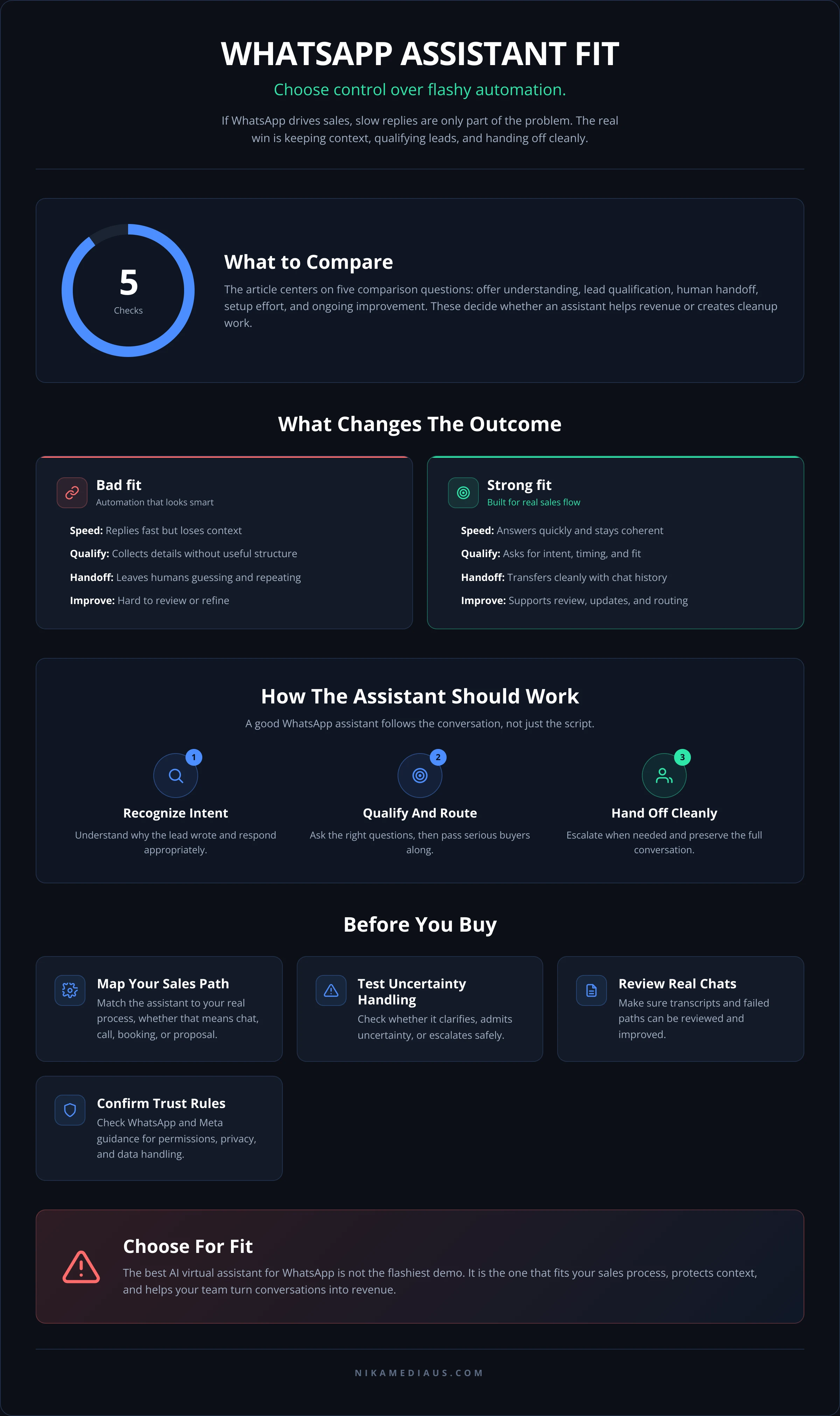
Questions to ask before you buy
A polished demo can hide a lot. Before choosing an AI virtual assistant for WhatsApp, ask the questions that reveal daily reality.
Can it follow the way we already sell?
If your process starts with a qualification chat, then a call, then a proposal, the assistant should support that sequence. If you sell mostly through instant booking, it should help complete that action quickly. A tool that forces your process into its own template usually creates friction.
What happens when it is unsure?
Every assistant will encounter uncertainty. The difference is whether it makes things worse or safely escalates. You want to know whether it admits uncertainty, asks for clarification, or hands off before it starts generating confident but inaccurate replies.
Who controls the tone and boundaries?
Brand voice matters more than many teams expect. If the assistant sounds too casual for a premium service, or too stiff for a conversational audience, it can damage trust. You should also know whether you can set boundaries around pricing, support scope, and sensitive questions.
Can we review real conversations?
This is essential for improvement. If you cannot review transcripts, identify failed paths, and refine the logic, the assistant becomes harder to trust over time. Teams that treat review as part of the workflow usually get better outcomes than teams that set and forget.
How does it support compliance and user trust?
For message handling and data use, review the official guidance for WhatsApp Business Platform and the Meta Business Help Center. If your assistant stores contact details or routes leads into follow-up systems, make sure your process respects user permissions, privacy expectations, and platform rules.
A business that handles these questions early is usually in a much stronger position than one that focuses only on the demo interface. That is especially true for services with longer sales cycles, where the assistant becomes part of the lead experience rather than a one-time responder.
Common mistakes when comparing platforms
It is easy to choose the wrong tool for the right reason. A business sees fast replies, a clean dashboard, or a confident demo and assumes the platform will solve the real problem. Then the assistant goes live and the conversations still require manual cleanup.
One common mistake is comparing message volume instead of conversation quality. Another is choosing a tool that can answer general questions but cannot route serious buyers properly. Some teams also underestimate how much effort is needed to prepare the knowledge base, define fallback rules, and connect the assistant to the rest of the sales system.
A different mistake is ignoring the human side of the process. If the team does not know when to step in, how to follow up, or where to find the conversation history, the assistant can make the workflow less clear instead of more efficient. That is especially painful in businesses where every lead matters and response timing affects conversion.
The same pattern shows up in other service categories too. Teams often invest in the visible tool while overlooking the process behind it, which is why mistakes happen in areas like recording studio rental decisions in Orlando, corporate video production planning in Orlando, and video marketing agency selection in Orlando. The lesson is the same: the service works best when the system behind it is clear.
How to choose the right fit for your business model
The right AI virtual assistant for WhatsApp for a local service business is not always the right choice for an agency, a creator-led brand, or a company with inbound support demands. Your model determines what “good” looks like.
If your priority is lead generation, the assistant should qualify quickly and pass along only useful conversations. If your priority is support, it should resolve common questions without frustrating the customer. If your priority is both, then separation matters: the assistant should know whether it is speaking to a buyer, an existing client, or someone requesting general information.
For businesses that want stronger sales support, it is worth thinking about the assistant as part of a larger revenue system. A campaign brings the lead in, the assistant keeps the conversation moving, and the human team closes the deal. That is also where a production partner like NIKA MEDIA can matter, because a good assistant performs better when the message, offer, and funnel are aligned.
The decision should also reflect how much hands-on control you want. Some teams prefer a highly managed setup with clear scripts and review. Others want flexibility for frequent changes. Neither is automatically better; the right option is the one your team can maintain without losing quality.
If you are comparing tools for a WhatsApp-first sales process, do not ask which one looks most advanced. Ask which one will still make sense after the novelty wears off, after the first round of lead feedback, and after your team has to use it every day.
A practical shortlist before you decide
Before you sign off on any platform, make sure you can answer these in plain language:
- What exactly should the assistant do with a new lead?
- Which questions should it ask before handing off?
- Who receives qualified conversations, and how fast?
- How will we review mistakes and improve the flow?
- What happens when the buyer asks something outside the script?
If those answers are clear, your AI virtual assistant for WhatsApp is more likely to support the business rather than distract from it. If they are not clear, the risk is not that the tool fails spectacularly. It is that it works just well enough to hide the problems.
FAQs
What is the main difference between a chatbot and an AI virtual assistant for WhatsApp?
A chatbot usually follows predefined paths and answers limited questions. An AI virtual assistant for WhatsApp can interpret intent more flexibly, manage a wider range of messages, and support handoff or qualification more intelligently.
How do I know if my business needs one?
If your team misses leads after hours, repeats the same answers all day, or spends too much time sorting basic inquiries, it is worth considering. It becomes even more useful when WhatsApp is part of your sales or customer service process.
Should I choose the cheapest option?
Not by default. A lower-cost tool can be fine if your needs are simple, but the cheapest option often lacks control, review tools, or proper handoff behavior. The better question is whether the setup will actually support your workflow.
Can an assistant replace a sales team?
No. It can qualify, route, and keep conversations active, but it should not replace judgment, relationship-building, or closing. It works best when it gives the team better conversations to work with.
What should I test first?
Test the most common real conversations your business receives. Focus on lead qualification, handoff, and how the assistant handles uncertainty. Those tests will tell you more than a polished demo.
If you want a WhatsApp assistant that fits your sales process instead of forcing your team to work around it, NIKA MEDIA can help you design the conversation flow, the handoff logic, and the content that supports it. The right setup starts with your actual lead questions, not with a generic automation template.
If you are ready to compare options based on how they will perform in daily use, talk to NIKA MEDIA about building an AI virtual assistant for WhatsApp that matches your offer, your follow-up process, and the way your team closes business.
- AI virtual assistant for WhatsApp
- WhatsApp automation for lead generation
- WhatsApp sales assistant
- AI customer support on WhatsApp
- WhatsApp lead qualification
- WhatsApp business automation
- sales automation for WhatsApp