
Common Corporate Video Production in Orlando Mistakes
August 30, 2026 · 11 min read
Avoid the most common corporate video production in Orlando mistakes that waste budget, blur messaging, and weaken lead generation.
The planning mistakes that weaken the whole project
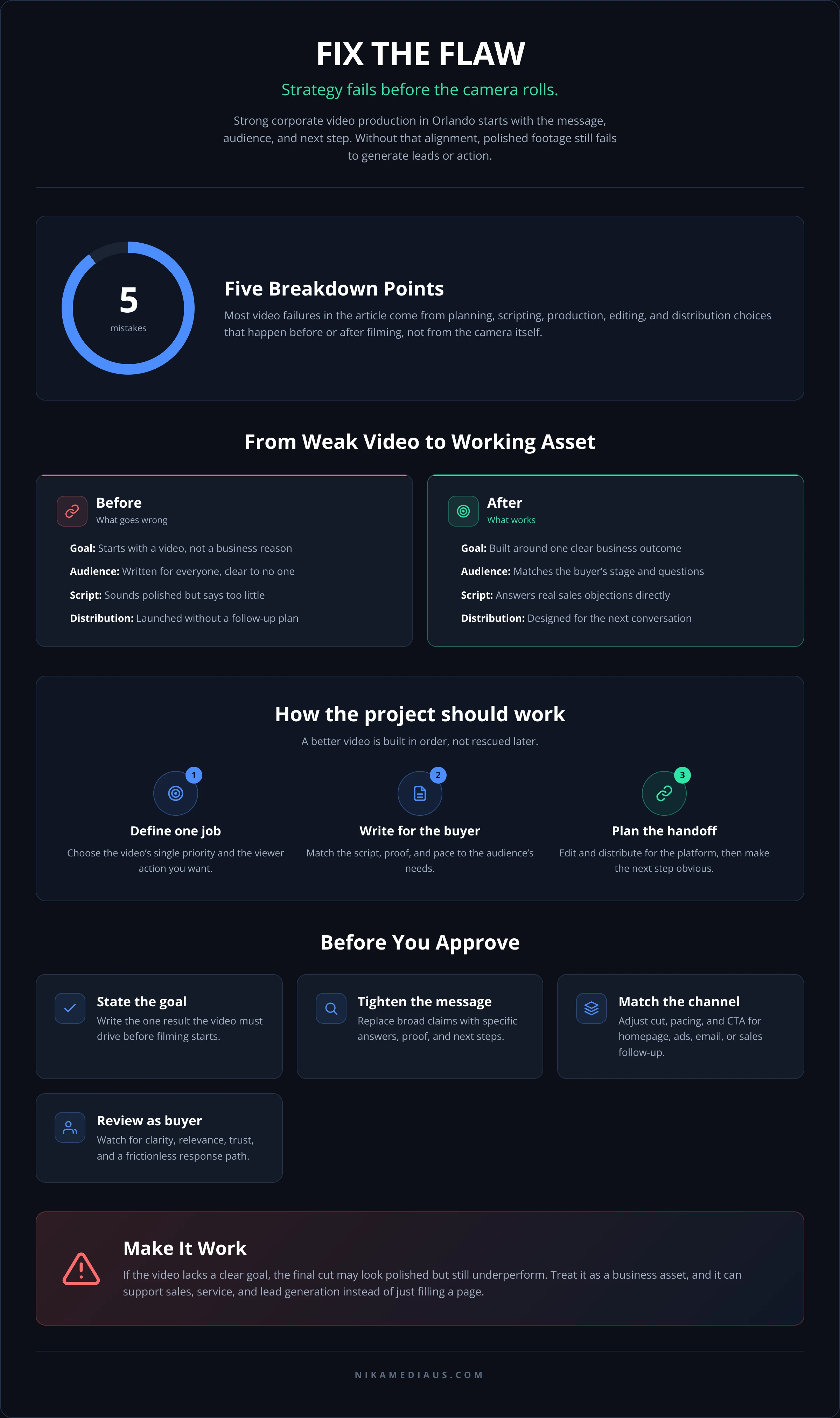
The first problem is starting with “we need a corporate video” instead of a business reason. A recruitment piece, a sales intro, a customer education video, and a founder story all ask for different structure, tone, and proof. When those goals get blended into one script, the viewer gets a little of everything and remembers almost nothing.
Another common planning miss is skipping the audience decision. A video aimed at first-time prospects should not sound like it was written for people already in your pipeline. The words, examples, and objections need to match the stage of the buyer. If the viewer has to work to understand why the message applies to them, the video has already lost momentum.
The same issue shows up when teams try to make one asset do every job. They want it on the homepage, in sales follow-up, on LinkedIn, and in paid ads. That sounds efficient, but it often leads to a bloated script and a weak call to action. A sharper approach is to choose the primary use first, then adapt the cutdowns later.
If you want a useful checkpoint before committing, ask one blunt question: what should the viewer do after watching? If the answer is fuzzy, the planning is still incomplete. This is one of the reasons many projects resemble the issues covered in Video Marketing Agency in Orlando Mistakes to Avoid, where the failure begins long before editing.
One practical way to protect the project is to define the video’s single priority in writing. It might be booking a consultation, starting a WhatsApp conversation, or moving a prospect from cold to warm. Once that priority is clear, every scene and line can be tested against it.
Script and messaging errors that sound polished but say too little
A lot of corporate videos sound professional and still feel empty because the script leans on broad language. Phrases like “innovative solutions” or “commitment to excellence” do not help a buyer decide anything. They create a smooth surface and hide the fact that the message never gets specific.
The better script answers the questions your sales team hears every week. What problem do you solve? What happens if the buyer delays? Why should they trust you now? A useful script does not need to be dramatic, but it does need to be direct.
A second messaging error is trying to explain the entire company history in one video. Internal milestones may matter to your team, but the viewer is usually looking for relevance, proof, and next steps. If the story gets buried under the origin tale, the viewer may understand your background and still not know whether to contact you.
This is where short, concrete proof helps. A process demonstration, a service walkthrough, or a clear before-and-after explanation usually works better than a general brand speech. If the business handles confidential documents, compliance-sensitive workflows, or authorization steps, linking to a credible external reference can help contextualize trust. For example, Jaminanotary is a useful model of how specific service framing makes a process feel less abstract.
When teams want the video to sound premium, they often over-script the speaker. That creates memorized lines that feel stiff on camera. A better approach is to write for clarity, then leave room for the speaker to sound like a real person. Viewers are surprisingly good at detecting when someone is talking to them versus performing for the camera.
Production choices that make the video look expensive but feel weak
Not every production problem is visible in the footage. Sometimes the lighting is fine, the camera is sharp, and the set looks clean, yet the video still feels flat because the creative choices were made without the viewer in mind. Corporate video production in Orlando often runs into this when the focus is on visual polish rather than communication.
One common trap is overcomplicating the scene. A busy office, too many props, or an environment that does not reflect how the company actually works can distract from the message. People notice when the setting looks staged in a way that does not fit the brand. A real environment, cleaned up and framed well, often feels more trustworthy than a generic “video set” look.
Sound is another area that gets underestimated. Viewers may forgive a frame that is slightly imperfect, but they lose patience quickly with echo, background noise, or a voice that feels distant. For any piece meant to support sales or customer support, audio quality is not a bonus feature; it is part of the message.
Teams also make the mistake of using talent who are not ready for on-camera delivery. That does not always mean hiring actors. It may mean coaching the founder, the account manager, or the technician so they can speak naturally under pressure. A few minutes of preparation can save hours of awkward footage later.
If the content will later support automation, paid campaigns, or sales follow-up, it helps to build with that distribution in mind. A video made for a landing page may need a stronger opening than one made for an email sequence. When the first ten seconds are weak, the rest of the production rarely gets a fair chance.
Editing mistakes that bury the message
Editing often gets treated like cleanup, but it is where the message becomes usable. A video can be beautifully shot and still fail because the edit moves too slowly, repeats the same point, or leaves too much space between ideas. That is especially risky when the viewer is a prospect who is comparing options and scanning for relevance.
One of the most common errors is keeping every usable clip. Teams get attached to lines they paid for, even when those lines do not help the viewer. The edit should protect attention, not preserve every second of footage. If a scene does not advance trust, clarity, or next action, it is probably costing you.
Another issue is adding visual effects to cover a weak structure. Transitions, music, and motion graphics can support the message, but they cannot replace it. If the video starts drifting, no amount of motion design will make the call to action feel urgent.
Captions also deserve more care than many teams give them. People may watch with sound off, especially on social platforms. But captions should support comprehension, not clutter the frame. If the text is too long, too small, or timed badly, it makes the video harder to follow rather than easier.
This is also where teams should think about the specific platforms the video will live on. A homepage cut, a paid ad, a LinkedIn post, and a WhatsApp follow-up clip are not the same product. Treating them as identical often creates awkward pacing. That overlap is one reason some brands run into the same issues described in AI Sales Call Automation Mistakes to Avoid, where the workflow looks efficient but breaks under real use.
If the video needs to support an automated lead flow, the edit should make the next step obvious. Do not make people guess whether they should book, reply, or visit a page. When the viewer has to interpret the next move, you lose part of the lead.
Distribution and follow-up errors that waste the finished asset
A finished video is not a finished result. If it sits on one page with no distribution plan, the business gets a content file instead of a sales tool. That happens often when the team spends most of the energy on the shoot and very little on where the asset will work hardest.
One mistake is launching the video everywhere at once without assigning a purpose to each channel. A video that helps close warm leads may not be the same cut that earns clicks from cold traffic. The message, length, and hook should change depending on the audience’s level of familiarity.
Another missed opportunity is failing to connect the video to the next conversation. If a prospect likes what they saw but has to dig for contact details or fill out a generic form, the friction rises. The easiest win is often a simple pathway: watch, understand, and respond.
This is where sales and service systems matter. A video can support chat, WhatsApp, booking, or a callback sequence, but only if the handoff is deliberate. When that handoff is vague, the lead cools off quickly. That is one reason some companies revisit their process after reading pieces like Common AI Virtual Assistant for WhatsApp Mistakes, because the video and the response system should work together.
It also helps to plan the first follow-up before the shoot. If the video is meant to prompt a consultation, the landing page should reflect that message. If it is meant to support a sales rep, the rep should know how to use it in the conversation. The asset performs better when the team treats it like part of a system, not a one-off file.
A sharper checklist before you approve the final cut
Before sign-off, watch the video as if you are the buyer, not the owner. Pause after the opening and ask whether the problem is clear. Pause again near the middle and ask whether the proof feels relevant. At the end, check whether the next step is obvious without any extra explanation.
A strong review process should catch a few specific issues:
- The opening takes too long to reach the audience’s real concern.
- The script says a lot about the company and little about the buyer’s decision.
- The visuals look polished but do not support trust or clarity.
- The video feels too long for the role it is supposed to play.
- The call to action is generic, buried, or disconnected from the message.
If a problem shows up in that review, it is usually easier to fix it before export than after launch. The final stage is not the place to rescue weak positioning.
For teams that handle lead generation, support, and sales follow-up together, this checklist is even more important. A video that feels “good enough” to the internal team can still underperform if it does not anticipate the viewer’s next decision. That is why experienced corporate video production in Orlando teams spend as much time on structure and distribution as they do on shooting day.
NIKA MEDIA works with brands and personal brands that need video to do more than look professional. If you want a project shaped around leads, customer communication, and a cleaner handoff into sales, start with the message and the workflow before you book the shoot. A short planning conversation can save you from building a video that looks finished but never earns its place in the funnel.
FAQs
What is the most common mistake in corporate video production?
The most common mistake is starting with visuals instead of the business goal. When the purpose is unclear, the script, style, and call to action usually drift.
How long should a corporate video be?
The right length depends on where the video will be used and who will watch it. A homepage or sales-support video should stay focused and avoid padding.
Should one corporate video be used on every platform?
Usually not. A main cut can be repurposed, but the hook, pacing, and call to action often need adjustments for each platform.
Why do some polished videos still fail to generate leads?
They may look good but fail to answer the viewer’s real questions. If the message is too broad or the next step is unclear, attention fades.
Is it worth planning distribution before filming?
Yes. Distribution affects the length, structure, and call to action. A video built for one channel often underperforms when forced into another without changes.
Need a corporate video that supports sales instead of just filling a website page? Talk with NIKA MEDIA about a production plan that connects the script, shoot, editing, and follow-up flow before anything gets filmed.
If you already have a video idea and are unsure whether it will generate leads, book a strategy session first. We can help you tighten the message, choose the right format, and avoid the production mistakes that make strong businesses sound generic on camera.
- corporate video production in Orlando
- corporate video mistakes
- Orlando video production
- corporate video strategy
- video marketing for leads
- corporate video planning
- sales video production
- brand video production