
AI Virtual Assistant for WhatsApp Pricing and Services
August 22, 2026 · 11 min read
Compare AI virtual assistant for WhatsApp pricing, services, and setup expectations for lead generation, 24/7 replies, and sales support.

Key takeaways
- An AI virtual assistant for WhatsApp is most useful when your inbox is busy, your team misses leads after hours, or the same questions keep coming back.
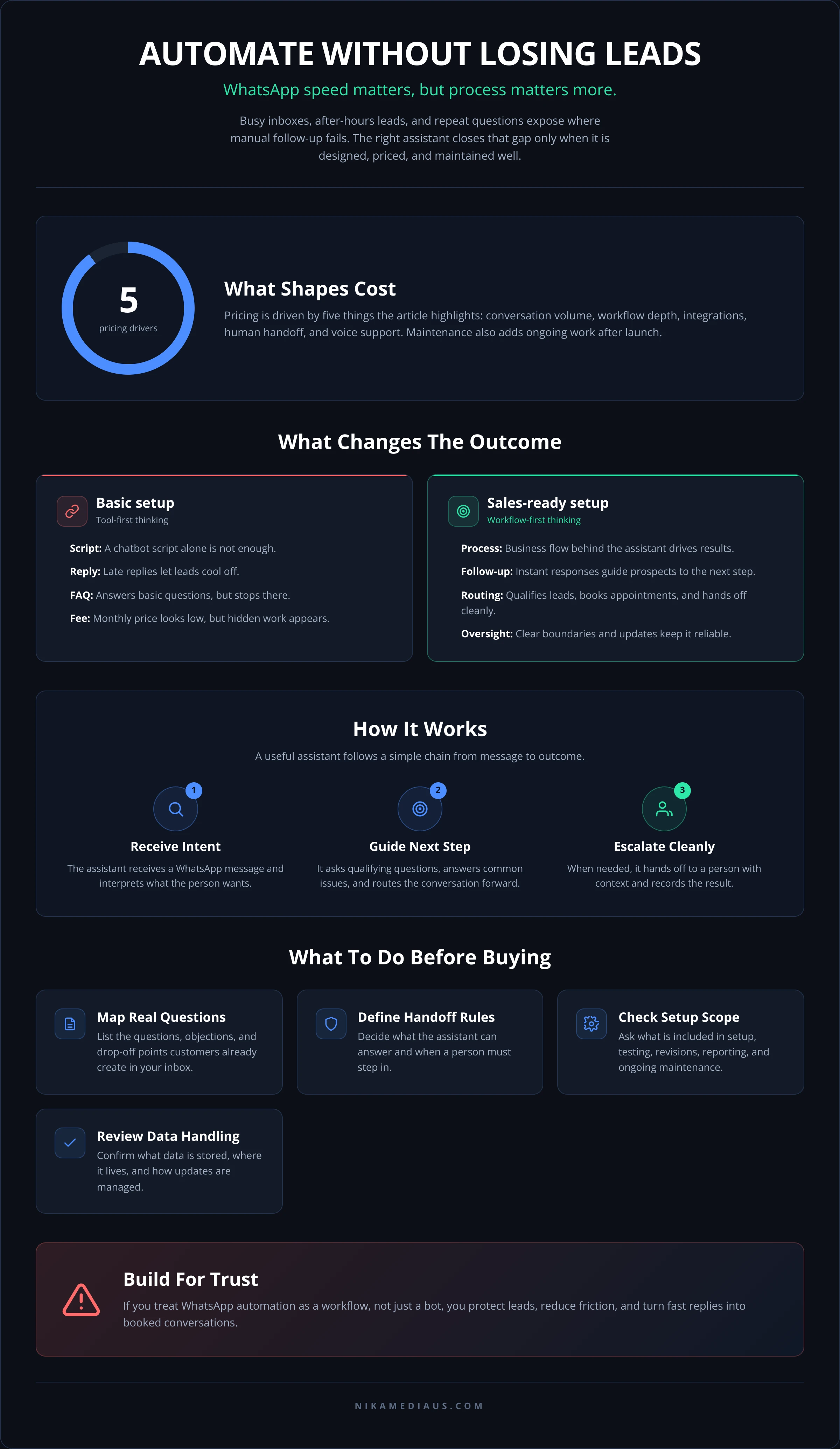
- Pricing usually depends on conversation volume, workflow complexity, voice or call handling, integrations, and how much human oversight you want.
- The biggest difference between a basic setup and a sales-ready one is not the chatbot script; it is the process behind it.
- If your business needs lead qualification, appointment booking, and follow-up, expect more than a plug-and-play tool.
- A good provider should explain boundaries clearly: what the assistant can answer, when it should hand off to a person, and how data is handled.
When a WhatsApp message comes in at 9:47 p.m., the problem is never just “reply late.” The real issue is what happens next: the lead cools off, the question goes unanswered, or someone on your team has to pick up their phone again. An AI virtual assistant for WhatsApp is usually brought in to solve that exact gap, but the results depend heavily on how it is designed, priced, and maintained.
For businesses that live on speed, follow-up, and trust, the promise sounds simple. The reality is more specific. You need to know what you are actually buying, what it can reasonably do, and where the hidden work shows up after launch.
AI virtual assistant for WhatsApp: what it actually handles
An AI virtual assistant for WhatsApp is not just a chat widget placed inside a messaging app. It is a system that receives messages, interprets intent, responds using defined business rules, and routes the conversation toward a useful outcome. That outcome might be an appointment, a qualified lead, a quote request, a support handoff, or a call with sales.
In a well-built setup, the assistant can handle the repetitive work your team does all day: answering common questions, asking qualifying questions, collecting contact details, confirming availability, and directing prospects to the right next step. If your business gets asked the same five questions repeatedly, that is where the assistant earns its keep.
The difference between a helpful assistant and a frustrating one is usually not the model itself. It is the conversation design. If the flow is too rigid, people feel trapped. If it is too open, the assistant drifts into vague answers that do not move the conversation forward.
For service businesses, the best use cases are usually tied to speed and follow-up. A prospect asks about availability, receives a quick response, shares their needs, and gets guided into the next step without waiting for office hours. For teams that also handle calls, a connected voice workflow can keep the same logic running across channels.
Pricing is shaped by the work behind the system
There is no honest single price for an AI virtual assistant for WhatsApp because the cost follows the complexity of the business process, not just the software. A light setup that answers FAQs and captures leads is very different from a system that qualifies prospects, syncs with a CRM, logs conversation history, and hands off to sales based on behavior.
What usually affects pricing:
- Conversation volume: more chats means more infrastructure, monitoring, and likely more usage-based cost.
- Workflow depth: a few scripted branches cost less than a multistep qualification flow.
- Integrations: connecting to calendars, CRM tools, forms, or booking systems adds setup time.
- Human handoff: if the assistant must escalate to staff with context intact, the implementation is more demanding.
- Voice support: if the same system is meant to support calls as well as WhatsApp, the project becomes broader.
- Maintenance: businesses change offers, hours, services, and policies; the assistant must be updated.
The biggest mistake is comparing only the monthly fee. A lower subscription can become expensive if it misses leads, creates support friction, or requires constant manual correction. On the other hand, an overbuilt system can be wasted money if your volume is too low to justify the complexity.
If you are evaluating vendors, ask what is included in setup versus what is ongoing. You want a clear answer about conversation design, testing, revisions, training, hosting or usage limits, and whether reporting is part of the package or an extra service. For messaging automation that touches business communications, it also helps to understand the channel rules from the source; WhatsApp Business Platform documentation is the most reliable place to verify what the platform supports.
Services that make the assistant useful, not just available
Most teams do not need “an AI bot.” They need a small stack of services working together. That often starts with discovery: mapping the questions customers actually ask, the objections that delay sales, and the moments where a human should step in.
From there, the assistant needs a conversation architecture. That means deciding how it greets people, what information it asks for first, how it qualifies intent, and how it avoids dead ends. A good setup sounds natural without pretending to be human in a way that feels deceptive.
The most valuable services around an AI virtual assistant for WhatsApp usually include:
Lead qualification and sales routing
The assistant can ask targeted questions that separate casual inquiries from serious prospects. For example, it can identify service type, urgency, budget range, location, or preferred timing before handing the lead to a person.
Appointment booking and follow-up
If your business uses scheduled consultations, the assistant can reduce back-and-forth by collecting enough information to book or request a slot. That saves time for both the team and the customer.
FAQ support and instant responses
When the same questions arrive daily, a fast answer prevents drop-off. Hours, service area, next steps, preparation instructions, and payment basics are common candidates.
Call and message handoff logic
Some conversations should not stay in automation. When a lead is ready, confused, or frustrated, the assistant should transfer the context cleanly to a human or route the person into a call.
Reporting and improvement
You need to know where people stop replying, which questions create friction, and which messages lead to booked appointments. Without that feedback loop, the assistant becomes a static script instead of a sales asset.
At this stage, businesses often realize they are not buying a single tool. They are buying a workflow. That is why agencies like NIKA MEDIA tend to frame the service around lead generation and content that converts, not just automation for its own sake.
What to expect during setup and the first month
The first expectation to adjust is time. A useful assistant is rarely ready from a blank page in a single afternoon. The work starts with clarity: what the business wants the assistant to do, what it must never do, and what success looks like when a conversation comes in.
Expect to review your current message patterns. Which questions do you answer over and over? Which ones should go to a person immediately? Where do leads usually disappear? If those answers are fuzzy, the assistant will be fuzzy too.
A practical launch usually involves a few rounds of testing. The goal is to catch awkward phrasing, missing branches, and edge cases before the assistant is exposed to real customers. That testing is especially important if the assistant will handle pricing questions, service availability, or sensitive requests.
You should also expect some human oversight after launch. Early conversations reveal gaps that are hard to predict on paper. People phrase the same request in different ways, and the assistant needs room to handle variation without sounding robotic.
If your team is also producing content to support the sales funnel, the assistant can work alongside stronger visuals, landing pages, and follow-up materials. That is one reason audiovisual strategy and automation often belong in the same conversation, not separate ones.
The signals that your business is ready for it
Not every business needs automation right away. The right question is whether the current process is creating friction that keeps showing up. If your team is answering leads late, missing people after business hours, or spending too much time on repetitive pre-sales questions, the case becomes stronger.
You are probably ready if three or more of these are true:
- Your inbox fills up with the same questions every week.
- Leads often ask for a response outside working hours.
- Sales people spend too much time qualifying basic inquiries.
- Your team loses track of conversation history across messages and calls.
- Booking or scheduling depends on manual back-and-forth.
- You have a clear offer and a repeatable sales process.
Readiness is not just about volume. It is also about clarity. If your offers, service areas, response times, and handoff rules are changing every week, the assistant will keep chasing a moving target.
If you operate in a sector with regulated or high-stakes communication, you also need to think carefully about compliance, consent, and data handling. For general U.S. consumer guidance on business practices and complaint channels, the Federal Trade Commission is a useful reference point. For legal-related intake or lead routing, some companies also separate the messaging layer from the actual case evaluation and use a qualified partner such as legalclaimconnectusa.com when the inquiry requires a specialized follow-up path.
How to evaluate providers before you sign
The best providers talk about outcomes, boundaries, and maintenance. The weaker ones talk only about “AI” and “automation” while staying vague about what happens when the conversation breaks.
Ask direct questions before committing:
- What exactly is included in setup?
- How do you design the conversation flow?
- What happens when the assistant cannot answer confidently?
- Can the system hand off to a person with context?
- How are updates handled when business hours, services, or offers change?
- What data is stored, and where?
- How do you measure whether the assistant is helping sales?
This is where a lot of businesses discover the difference between a software vendor and a service partner. A software-only setup may be fine if you already have a strong internal team to manage the details. If not, you may need a provider who can build, test, adjust, and keep the system aligned with your customer journey.
It also helps if the provider understands content and conversion, not just automation. When the same business also needs video assets, studio production, ads, or funnel support, one disconnected tool is rarely enough. That is why some companies compare messaging automation with broader marketing partners, not just chatbot builders. For that side of the decision, Choosing a video marketing agency in Orlando can help clarify what a strategy-first provider should look like.
Building a setup that supports leads, service, and trust
A strong AI virtual assistant for WhatsApp should make the buyer feel helped, not processed. That means the tone matters, but so do the operational details. If the assistant is too eager, it can feel pushy. If it is too vague, it wastes the opportunity.
The healthiest setups reflect the real customer journey. A new lead may need a quick answer and a simple next step. A returning customer may need service status or a direct handoff. A hot prospect may need fast routing to sales. Each path should feel intentional.
That is also why visual and message consistency matter. If your content looks polished but your messaging is slow or disorganized, the experience feels broken. A business that uses a studio, strong video, and automation together usually looks more credible than one that treats each tool as a separate project. If your team is also producing interviews, ads, or brand content, the Recording Studio Rental in Orlando: FAQs and Advice and Corporate Video Production in Orlando FAQs pages are useful references for how production support can fit into a broader lead generation system.
The point is not to automate everything. The point is to remove the friction that stops a prospect from moving forward. When the assistant handles the first layer well, your team gets to spend more time on the conversations that actually need human judgment.
FAQs
How much does an AI virtual assistant for WhatsApp cost?
Cost depends on the scope of the project. Simple FAQ automation is usually different from a sales-focused system that qualifies leads, books appointments, and integrates with other tools. Pricing also changes based on message volume, revision needs, and whether voice support or human handoff is included.
Can it replace a human salesperson?
It can replace repetitive first-step tasks, but not the strategic parts of selling. The assistant is strongest at responding fast, collecting details, and routing qualified conversations. A human still matters when the lead has objections, special requirements, or needs a custom offer.
What kinds of businesses benefit most?
Businesses that receive repeated inquiries, need quick follow-up, or rely on appointments usually see the most value. Service companies, local brands, and agencies often benefit when response speed affects conversion.
Does WhatsApp automation work for both sales and support?
Yes, if the flows are separated clearly. Sales questions, support issues, and post-sale requests should not be forced into one path. A good setup routes each conversation type where it belongs.
How long does setup usually take?
It depends on how complex the flow is and how quickly the business can approve messaging, offers, and handoff rules. A simple setup may move faster than a multi-step system with integrations and voice support.
What should I prepare before starting?
Bring your common customer questions, service list, response rules, business hours, and any points where a human must step in. The clearer your process, the better the assistant will perform.
If your inbox is already slowing down response time, the next move is to map the conversations that cost you the most leads. NIKA MEDIA can help you turn those messages into a practical WhatsApp sales system, supported by the right content and handoff logic instead of guesswork.
If you want a setup that fits how your team actually sells, start with a short strategy session. That is the fastest way to find out whether an AI virtual assistant for WhatsApp should handle FAQs, qualify leads, support calls, or all three in a way your business can actually maintain.
- AI virtual assistant for WhatsApp
- WhatsApp AI assistant
- WhatsApp automation for leads
- AI sales assistant for WhatsApp
- WhatsApp lead qualification
- WhatsApp customer support automation
- WhatsApp business automation