
AI Sales Call Automation: Compare Options
September 2, 2026 · 11 min read
Compare AI sales call automation tools with confidence using practical criteria for calls, follow-up, compliance, and lead handling.

- The cheapest tool is not always the one that saves the most time.
- A strong voice agent can help with lead qualification, but weak routing creates more work for your team.
- The best option for sales calls depends on call volume, follow-up speed, and how much control you want.
- If you already use WhatsApp, your call automation should fit your messaging flow instead of creating a separate process.
- Compliance, escalation, and recording behavior matter more than flashy demos.
A missed inbound call is not just a missed ring. It is a prospect who may already be comparing you with two or three other businesses before your team even sees the notification. That is why AI sales call automation deserves a careful comparison, not a quick demo-day decision.
The problem is familiar to anyone running a busy sales desk or handling leads for clients: one platform sounds impressive, another promises faster follow-up, and a third claims it can “replace” a rep. The real question is simpler and harder at the same time: which system can answer, qualify, route, and hand off a call without creating confusion for your team or friction for the caller?
AI sales call automation: what to compare first
When people compare tools, they usually start with voice quality. That matters, but it is not the first filter. Start with the job the system has to do. For some businesses, the goal is to answer after-hours inquiries and collect the basics. For others, the goal is to qualify leads, book appointments, and pass high-intent conversations to a human without delay.
That is where AI sales call automation separates into two very different categories: simple answering systems and revenue-facing systems. The first group can handle basic reception tasks. The second has to understand intent, follow a conversation path, and know when to stop talking. If a tool cannot be interrupted, cannot escalate cleanly, or cannot keep the caller moving toward a next step, it may sound polished but still fail the job.
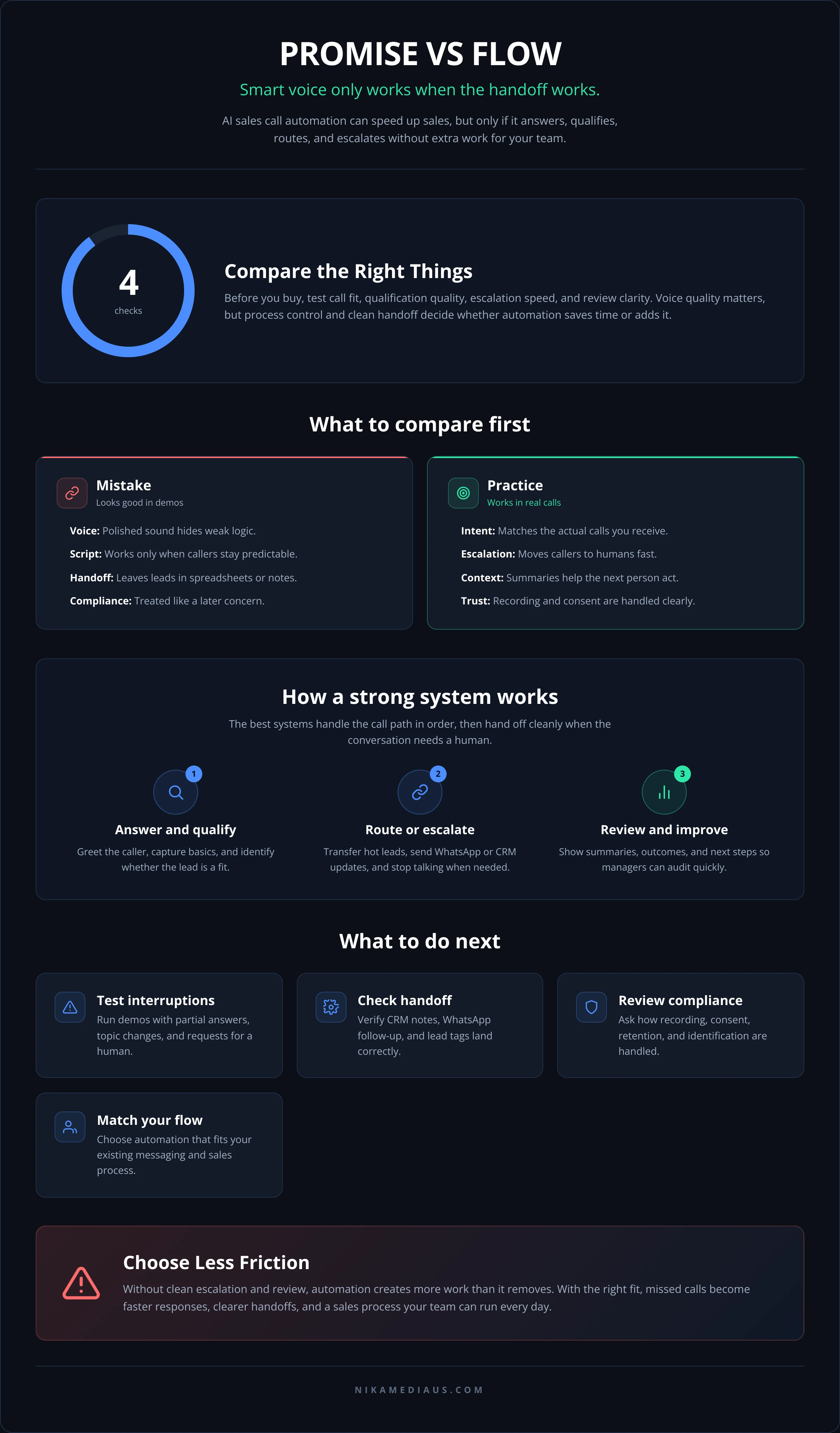
A useful comparison starts with four questions:
- Can it handle the type of calls you actually get?
- Can it qualify without becoming robotic?
- Can it route to the right person or channel fast?
- Can your team review what happened without digging through a mess of notes?
If you already manage lead flow through chat, the comparison should also include how voice handoff connects to messaging. In many businesses, the caller does not want a long script. They want an answer, a next step, and a fast path to whoever can help.
What separates a strong system from a noisy demo
A demo can hide a lot. Sales call automation looks great when the script is short, the customer is polite, and nothing unexpected happens. Real calls are less tidy. People interrupt, change topics, ask about pricing before qualification, and give partial answers that still matter.
A solid system handles that mess without sounding confused. It should recognize when a caller is ready to book, when they need a human, and when the call should end because the lead is not a fit. If the platform cannot manage those transitions, your team ends up listening to recordings and correcting the system manually.
One of the best ways to evaluate AI sales call automation is to test how it behaves when the conversation is slightly inconvenient. Ask about edge cases: a caller who wants to speak in a different tone, a lead that gives incomplete contact details, or someone who asks for the manager immediately. If the platform only performs when the script goes exactly as expected, it is not ready for revenue work.
Look carefully at the system’s memory too. Does it remember what was said earlier in the call? Can it keep the context when the caller circles back? Can it summarize the call clearly for the next person on the team? These details are not cosmetic. They affect whether the automation actually reduces manual work or simply moves the work to a different screen.
For teams already thinking about how voice and chat should work together, our internal comparison of AI Virtual Assistant for WhatsApp: Compare Options can help you see where the same lead may need both channels, not one or the other.
AI sales call automation and the lead handoff problem
Most problems appear at the handoff. A lead is qualified, but nobody gets notified. A caller asks for a callback, but the request lands in a spreadsheet someone checks later. Or the system sends a full transcript to the team, but nobody can tell what the caller actually needs.
If a platform cannot hand off cleanly, it does not matter how convincing the voice sounds. A good setup should transfer the lead with enough context to help the next person act quickly. That means the summary should be readable, the contact details should be accurate, and the next step should be obvious.
The best comparisons include the handoff path across channels. Maybe the call should create a CRM note, trigger a WhatsApp message, or alert a closer who can respond right away. Maybe the lead should be tagged as hot, warm, or not ready. None of that is glamorous, but it is where AI sales call automation either supports the sales process or becomes another disconnected tool.
A practical test: ask what happens when the system reaches the limit of what it can answer. Does it escalate naturally, or does it continue looping through phrases? Can it leave the conversation in a state your team can understand in 10 seconds? If the answer is unclear, you will feel that uncertainty later when leads slip through.
How to compare voice quality, logic, and control
Voice quality matters because people can tell quickly when a call sounds unnatural. But a pleasant voice with weak logic is still a bad business choice. Compare the following areas together, because they work as a set.
Voice behavior
Listen for pacing, interruptions, and the ability to handle short answers. A call flow should not force a caller to wait through a long monologue before responding. If the system sounds smooth but ignores the caller’s cues, the experience breaks down fast.
Conversation logic
The platform should ask the right questions in the right order, but not over-ask. A prospect who already shared their service need should not be dragged through irrelevant qualification. Good AI sales call automation feels focused, not repetitive.
Control for your team
Your team should be able to update scripts, business hours, routing rules, and escalation triggers without needing a technical ticket for every change. If minor updates are hard, the system will drift away from your real process.
Reporting and review
You need more than a call log. Look for summaries that show why the lead was qualified or rejected, what action followed, and where the call came from. Without that context, the system becomes hard to trust.
If you want a benchmark for how much operational clarity matters, even something as simple as a recording studio rental checklist can teach the same lesson: a polished front end does not fix a weak process behind it. The same principle applies when comparing voice automation.
Compliance, recording, and trust signals
Sales calls often cross state lines, business categories, and expectations about recording. That makes compliance part of the buying decision, not an afterthought. You do not need legal theater; you need a system that makes responsible handling easier.
Before choosing a platform, check how it behaves around recording notices, consent prompts, and retention. If your team handles sensitive inquiries or appointment-setting calls, the platform should support a clean process that fits your policies. The FCC consumer guidance is a useful starting point for understanding communication-related rules, and the FTC business guidance can help you think about claims, disclosures, and customer protection.
Trust also affects caller behavior. People are more willing to continue a conversation when the system sounds transparent and consistent. If the voice is overly aggressive, overly casual, or unable to identify itself properly, the caller may disconnect before the qualification is finished.
That is also why a hidden or vague escalation path is a red flag. If someone asks to speak to a human, the answer should be direct. A system that keeps talking past that point does not create confidence; it creates friction.
A practical comparison framework for your team
When you compare options, keep the scorecard simple. You are not buying a science project. You are choosing a system that has to survive real leads, real interruptions, and real team handoffs.
Use a short evaluation framework:
1. Call fit — Does it match inbound sales calls, support calls, or both?
2. Qualification quality — Can it capture the information your team actually uses?
3. Escalation speed — What happens when the caller needs a person now?
4. Channel fit — Does it connect with the way you already communicate with leads?
5. Operational control — Can you change the flow without a long delay?
6. Review clarity — Can managers see what happened and why?
If a vendor cannot explain one of these points clearly, keep going. A strong AI sales call automation setup should make your process simpler to run, not harder to audit. And if you are comparing the voice layer with broader content or campaign work, review how your calls connect to the rest of the funnel; a great call system cannot rescue a weak offer or a confusing ad.
That is why we often see businesses benefit from aligning automation with video, lead capture, and follow-up rather than treating the call system as a standalone gadget. For teams that produce customer-facing content, our article on Common Corporate Video Production in Orlando Mistakes shows a similar pattern: execution quality matters most when it supports a clear business goal.
When AI sales call automation is worth it, and when it is not
The best use case is usually not the loudest one. If your team misses calls after hours, answers the same questions over and over, or spends too much time sorting basic leads from serious ones, automation can help immediately. It can capture interest while the prospect is active and keep the sales process moving when no one is available to answer live.
It is less useful when the call requires deep judgment from the start. If every conversation is high-stakes, highly custom, or depends on nuanced consultation, then a full automation layer may frustrate the caller. In those cases, a lighter system that filters, routes, and books may be better than one that tries to “close” every call.
A good rule: automate the repetitive part of the conversation first. That usually means greeting, qualification, routing, and follow-up. Leave complex objection handling, custom pricing, or delicate exceptions to a human unless you have a very controlled environment.
If your business also depends on local brand presence, studio-based content, or live promotional work, think about how call automation fits into the overall customer journey. NIKA MEDIA works with businesses that need both operational systems and conversion-focused content, so the best setup is usually the one that respects how your leads already move through the funnel rather than forcing them into a new habit.
FAQ
How do I know if AI sales call automation is a fit for my business?
If your team loses leads to missed calls, slow response times, or repetitive qualification tasks, it is worth comparing options. The strongest fit is usually a business with steady inbound interest and a clear next step after the first call.
Should I choose a voice agent or a live answering service?
Choose based on the job. A voice agent can handle consistent qualification and routing, while a live service is better when the caller needs a human presence immediately. Many teams need a mix of both.
What should I test during a demo?
Test interruptions, partial answers, escalation, call summaries, and what happens when the caller asks for a human. A demo that only works on a perfect script will not tell you much about real performance.
Does AI sales call automation replace the sales team?
No. It should remove repetitive work, improve speed, and help the team spend more time on meaningful conversations. If a tool is positioned as a total replacement, be cautious.
What should I ask about compliance?
Ask how the platform handles consent, recording, retention, and identification of the automated system. If your calls cross state lines or involve regulated services, get clear answers before rollout.
If you want help comparing the right call flow for your sales process, NIKA MEDIA can review your lead journey and map where voice automation, WhatsApp follow-up, and human handoff should meet. That conversation is most useful when your current system already feels busy but still leaks leads.
If you are ready to turn missed calls into a more controlled sales process, reach out to NIKA MEDIA and ask for a comparison of your current call handling versus a tailored AI sales setup. The best next step is not a bigger tool; it is a cleaner flow that your team can actually run every day.
- AI sales call automation
- voice AI for sales calls
- call automation software
- AI call answering
- sales call routing
- AI phone assistant
- lead qualification automation
- automated sales calls
- call handoff automation
- AI virtual assistant