
AI Sales Call Automation Pricing and Services
August 23, 2026 · 11 min read
AI sales call automation pricing, services, and expectations for businesses that want 24/7 lead handling, better follow-up, and cleaner sales calls.
What AI sales call automation actually handles
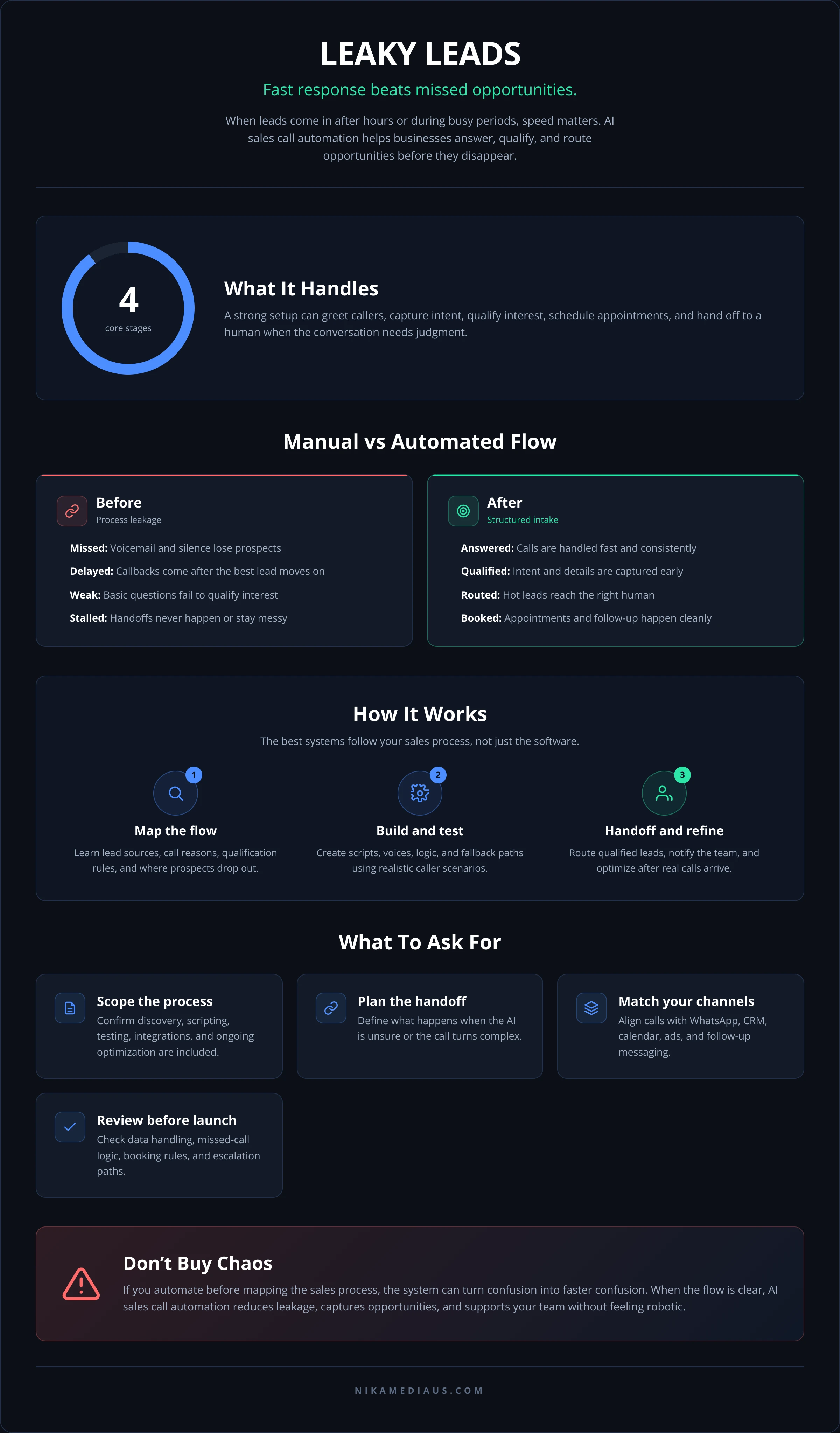
In a sales setting, this system listens, asks, responds, and routes. It can greet callers, capture intent, collect basic details, qualify interest, schedule appointments, answer common questions, and hand off to a human when the conversation becomes complex or high-stakes. The better systems also keep the tone consistent so the interaction feels like a structured intake process instead of a scripted robot.
That matters because most businesses do not lose leads from one dramatic failure. They lose them in small moments: a missed call, a delayed callback, a weak qualifying question, or a handoff that never happens. [AI sales call automation](#) is useful when it reduces those leaks without forcing your team to chase every inbox thread by hand.
What it can and cannot do well
It works best when the task is repeatable. New lead intake, basic qualification, booking, reminders, simple objections, and follow-up messages are all good candidates. It is weaker when the call requires nuance, legal judgment, emotional sensitivity, or a decision that depends on context the system does not have.
That is why a realistic setup includes guardrails. If a caller is confused, upset, or asking for something outside the approved flow, the system should not improvise endlessly. It should transfer, notify, or create a clean record for a human to review.
For businesses that use WhatsApp heavily, pairing the call flow with AI Virtual Assistant for WhatsApp Pricing and Services can tighten the handoff between phone, text, and booking follow-up.
How pricing is usually structured
There is no single price for [AI sales call automation](#) because the cost follows the level of customization and the amount of work needed after launch. A basic package may cover a narrow call flow and standard setup. A more advanced engagement often includes discovery, scripting, recording or voice selection, testing, revisions, CRM or calendar integration, and ongoing tuning.
The most useful way to judge pricing is to separate software from service. Some providers sell access to a platform. Others provide a done-for-you build. Many businesses need both, because the software is only useful when the logic, language, and routing match the actual sales process.
Pricing components you should ask about
Ask whether the proposal includes:
- Discovery of your current sales process and lead sources
- Call script writing and revisions
- Voice configuration and prompt engineering
- Appointment booking or lead qualification logic
- Integration with calendars, CRMs, or messaging tools
- Testing and call scenario review
- Post-launch support and optimization
If a proposal is vague on those points, the price may look attractive but the implementation will likely require more back-and-forth later. That usually becomes more expensive than paying for clarity up front.
There is also the question of volume. Some businesses only need the system to answer overflow calls and capture after-hours leads. Others want it to act as the first layer of intake all day. Those two use cases create very different service demands.
For a broader comparison of service structure and expectations, it can help to read how similar work is scoped in Corporate Video Production in Orlando FAQs and Recording Studio Rental in Orlando: FAQs and Advice, because the same principle applies: scope determines cost, not just the headline offer.
What makes one quote higher than another
Two proposals may mention the same phrase, but one may be much more expensive because it includes strategic work. If a provider is mapping call outcomes, designing fallback paths, testing edge cases, and aligning the system with marketing campaigns, that is a different job from simply turning on a tool.
Expect higher pricing when the project needs:
- Multiple call types or departments
- Custom objection handling
- Multichannel follow-up
- Ad campaign alignment
- Human escalation rules
- Voice and brand consistency work
A low price can still be fine if your use case is narrow. But if your main goal is to stop losing qualified leads, the cheaper option often costs more in missed opportunities.
Services that make the system useful after launch
The build is only the beginning. A useful [AI sales call automation](#) service should keep working after the first round of setup, because call behavior, lead quality, and offer changes all affect performance. If the system is never reviewed again, it can become stale fast.
This is where service quality shows. Good providers do not just hand over a configuration. They help you refine the questions, identify where callers get stuck, and adjust the flow when your business changes offers, hours, or lead sources.
Core services worth expecting
A serious offer usually includes some mix of the following:
- Call flow strategy based on your real sales process
- Copy and conversation design for the first contact
- Testing across common caller scenarios
- Calendar or CRM handoff setup
- Lead capture and follow-up planning
- Reporting on where calls start, stall, or transfer
- Ongoing optimization after launch
That last point matters more than most owners expect. The first version is rarely the best version. Once the system starts handling real people, it reveals where the script is too long, where the offer is unclear, or where human intervention is still needed.
If your business also produces content that supports sales, it can be smart to align the automation with video assets, landing pages, and ad campaigns. That is where NIKA MEDIA often fits naturally: production, automation, and lead flow should support the same conversion path, not live in separate silos.
What service should feel like
You should not feel like you are buying a mystery box. A good provider explains the decision points, shows where the AI will speak, and identifies where the handoff happens. If the setup touches voice, call recording, storage, or customer data, there should also be a clear explanation of how those pieces are handled.
If the vendor cannot explain the customer journey from first call to booked appointment or qualified lead, that is a warning sign. The technology may work, but the business result will be messy.
What to expect during implementation
The first step is usually not technical. It is operational. Someone needs to learn how your leads currently come in, what the main call reasons are, how your team qualifies prospects, and where prospects usually drop out. Without that, the automation guesses instead of supporting the sales process.
After that, the provider should build the call logic and test it against realistic scenarios. Expect revisions. Good call automation is shaped by the awkward cases: partial answers, unclear intent, wrong service requests, callers who jump ahead, and people who only want to confirm a detail before booking.
Questions to settle before launch
Before the system goes live, make sure these are clear:
- What happens if the caller asks something outside the script?
- Who gets notified when the AI qualifies a lead?
- What data is stored, and where?
- How are missed calls handled?
- What is the fallback if the AI cannot understand the caller?
- Which appointments are auto-booked, and which require review?
This is also where compliance and trust come into play. If your process includes call recording, customer data, or identity verification, the system should respect applicable rules and internal policies. For general legal and notary-related processes, a resource like Jamina Notary can be useful when your workflow needs official documentation rather than a sales conversation.
The best implementations are boring in a good way. Calls are answered, information is captured, and the right people get the right follow-up without the team rebuilding the process every Monday morning.
Signs the setup is too shallow
A shallow build often looks polished during the demo and weak in the real world. The script sounds good, but it does not reflect how prospects actually talk. The response times are fast, but the logic is brittle. The handoff exists, but the human team still has to clean up the mess.
Watch for providers who focus almost entirely on the tool and almost never on your sales process. If no one asks about lead sources, caller intent, appointment rules, or the difference between a good lead and a low-value inquiry, the system may automate noise instead of revenue.
Red flags during the sales process
Be careful if you hear any of these patterns:
- “We can set that up quickly” without asking about your actual workflow
- No discussion of escalation or handoff
- No testing with realistic caller scenarios
- A one-size-fits-all script
- No plan for follow-up after the call
- No explanation of what happens when the AI is uncertain
Another red flag is overpromising tone. If a vendor says the system will handle every call perfectly, that is not a serious answer. Good automation reduces friction and captures opportunity; it does not remove the need for human judgment.
The most durable systems are built with limits. They know when to continue, when to pause, and when to hand the conversation to a person.
Choosing a provider that fits your growth stage
A small local business, a growing service brand, and a multi-offer operation do not need the same setup. A company that wants after-hours lead capture may need a straightforward flow and a simple handoff. A brand running ads, booking consultations, and following up through multiple channels usually needs a more integrated system.
That is why [AI sales call automation](#) should be evaluated alongside your other marketing assets. If your ads generate the leads, your calls qualify them, and your content builds trust, all three need to point in the same direction. Otherwise the customer sees one message in the ad, another on the phone, and a third in the follow-up.
At NIKA MEDIA, that usually means thinking in terms of the full conversion path: audiovisual production, lead capture, virtual sales support, and campaigns that do not fight each other. For some businesses, the studio, the content, and the automation all support the same pipeline. For others, only one piece is needed first.
A practical way to compare providers
When you are comparing offers, ask yourself:
- Does this provider understand how my leads actually come in?
- Can they explain the exact call journey?
- Do they build for my current sales team, not an imagined one?
- Will they support revisions after real-world testing?
- Is the price tied to strategy, setup, and support, or just access?
If the answers are vague, the project may still work, but you will carry more of the burden. The right setup should reduce operational pressure, not create another piece of software that only one person in the company understands.
FAQs
How long does implementation usually take?
It depends on how complex the call flow is and how many systems need to connect. A simple lead-capture setup is faster than a multi-step sales process with routing, booking, and follow-up.
Do I need a CRM before using AI sales call automation?
Not always, but it helps. If you already use a CRM, the system can push cleaner lead data into a place your team already trusts.
Can it replace a sales rep?
It can handle repetitive intake and qualification tasks, but it should not be treated as a full replacement for human judgment. High-value, sensitive, or unusual conversations still need people.
What is the biggest mistake businesses make?
They buy the technology before defining the sales process. When that happens, the automation reflects chaos instead of improving it.
Is this better for phone calls or WhatsApp?
It can support both. Many businesses get the best results when calls and messaging work together, so prospects can move from one channel to another without repeating themselves.
If your current lead flow feels leaky, the next step is to map the first conversation before you buy anything else. NIKA MEDIA can help you design the call logic, align it with your content and campaigns, and build a system that handles leads more cleanly from the first ring to the booked appointment.
If you want a setup that is built around your sales process instead of forcing your team to adapt to software, reach out and ask for a scope review. That is the easiest way to see whether [AI sales call automation](#) will save time, improve follow-up, and support the way your business already sells.
- AI sales call automation
- sales call automation pricing
- AI phone lead qualification
- automated sales calls
- AI virtual sales assistant
- call automation services
- AI appointment booking
- WhatsApp and call automation